Heuristic Rotating Header Image

Something else entirely

I was going to write something about National Novel Writing Month and how I’m tweaking the rules this year to get some of the mass enthusiasm without any of the nervous breakdown, but. I saw this instead, and am too angry about it to write about anything else.

Nature, one of the premier scientific journals, regularly publishes science fiction stories, which I think is fantastic. A number of authors I respect have featured in it, and I’d like to do so myself one day.

But this story? Not at all pleasing. “Womanspace,” by Ed Rybicki, was intended as a tongue-in-cheek mostly-true anecdote about two inept middle-aged men (as stated by the author, himself one of those men). That would be fine with me. I know plenty of inept men, and quite a few of them are covered for by incredibly competent women.

Where Rybicki goes wrong is extrapolating from his single data point to ALL men, and particularly ALL women. Men are hunters, you see, and women are gatherers, and as such women have miraculous shopping powers which extend to retrieving goods from parallel universes that men can’t access.

The story buys into stereotypical ideas in other ways: the two men are busily discussing plans for a technical book while the protagonist’s wife cooks dinner. She recalls a domestic purchase that she hadn’t had time to make, and sends the men off to do it. So the woman is in charge of cooking and shopping, except on special occasions where it’s necessary to send the men out for something even though they’re doing something important? The shop staff are of course female as well, as necessary to his point.

Just as aggravating, the story made the open assumption that everyone reading such a prestigious journal would be male, and would have a wife at home.

I’m willing to give Rybecki the benefit of the doubt here. He and his friend and his wife had a funny anecdote, and were all amused, and he wrote it up without thinking too hard about about. After all, middle-aged males in the sciences are often oblivious to issues of stereotype and discrimination regardless of the number of training sessions they’ve sat through. (He says in his comments that some of his best friends are women “my own (better-paid) professional wife thought it was funny,” which doesn’t really help his case but was enough to pass his own personal filters.

But WHAT were the editors thinking? I expect more thought from the editorial staff, and that’s where I place the major share of the blame here. It’s 2011, and we’re still dealing with outdated stereotypes about the roles and mental processes of men and women, even here among purportedly-enlightened scientists?

Oh wait. I knew that.

Zombies are coming!

Last year, Tamie got me a zombie to celebrate the launch of Rigor Amortis. This year, she got him an undead girlfriend. (She obviously hasn’t read my story, or she would have gotten two girls instead.)

Zombie boy is courting her quite sweetly.

They even went on a date this afternoon.

And now they’re sitting in the candy bowl awaiting trick-or-treaters. (I hope they’re not oozing.)

Happy Halloween!

Look to the sky

I admit it, I wrote fiction last night instead of writing my Ada Lovelace Day post. Tsk. But I wanted to tell you about a woman of science anyway, even a day late.

In 2009, I wrote about a woman who’d influenced me even though she was long dead. Last year I wrote about a woman who helped to pave the way for others to enter traditionally male fields like medicine and science.

This year, I chose Maria Mitchell, the first female professional astronomer in the United States. Born on Nantucket in 1818, she attended Cyrus Peirce’s school for young ladies but was largely self-educated.

Discovering a telescopic comet in 1847 was the result of much hard work, study, and time spent behind a telescope, but it seems to have been what brought her to the notice of the scientific establishment. Prior to that, she was a teacher and librarian, both acceptable female professions.

Afterward, her life must have changed dramatically. She became the first woman member of the American Academy of Arts and Sciences in 1848 and of the American Association for the Advancement of Science in 1850. She became the first professor of astronomy at Vassar College in 1865.

Mitchell was also active in the women’s suffrage movement, and in protesting slavery. She must have been ferociously brilliant, and worked very hard at her passions, but also stood up for what she thought was right.

If you’d like to know more, Google books has a collection of Mitchell’s writings published in 1896, seven years after her death.

(And yes, I did recently read Juniper, Gentian, and Rosemary, by Pamela Dean.)

All the Tea in China

A tiny crescent moon, just past new, hovered in the west. Rick hadn’t seen so many stars in years. Ruined castles were a good place to escape light pollution, he supposed. And with no roof on this section, there was nothing to interfere with moongazing. Not that he had any interest in that himself. Of course, if he’d been the one to relocate an entire thirteenth-century ruined castle from Normandy to Newfoundland, he would have at least put the roof back on.

“How the fuck can you do that,” he asked? The object of his inquiry was sprawled on a folding lounge chair, a sidecar in one hand and a bowl of smarties at his side. Even as Rick watched, he popped a few more smarties into his mouth, and washed them down with his cocktail.

“Do what, my dear?” Arthur asked, not taking his gaze from the sky.

“Smarties and cocktails. Yuck.”

“Smarties improve brain function, thus the name. But only the blue ones.” Arthur looked down at his drink before returning his gaze to the sky. “And sidecars make me happy. Smart and content: I generate my best ideas that way.”

Rick hoped Arthur would choke on his smarties.

“And what the fuck are we doing way out here anyway?”

“I came for the peace and quiet,” Arthur replied. “And you came because I pay you. And you are interfering with the peace. And the quiet. Kindly cease.”

Rick scowled, but only because it was too dark for Arthur to see his expression.

Arthur leaned back, setting his drink down so he could point at the moon. “See that?” he asked, but Rick didn’t think his boss was really talking to him. “That’s the same crescent moon that shone over Sarajevo on the 28th of June, the night that this whole chain of events were set in motion.” He lifted his drink again, slugged it, then threw the glass into the darkness. It crashed against a crumbling wall that was faintly silhouetted against the stars and disturbing the geese who were roosting there. They were probably Canada geese, Rick supposed, or at least Canadian. “A war began that day, a global catastrophe that resulted in the love of my life never having been born.”

Rick knew better than to ask how Arthur could possibly know that some unborn woman would have been the love of his life. Or man, maybe. Rick had never seen Arthur in a relationship of any sort. Whatever.

All Rick knew is that he didn’t want to listen to this. He retreated quietly into one of the more intact rooms, where he could at least have a battery lantern. Some kind of hippie group had been living here, or reenactors, or some shit like that, and they’d left a bunch of crap. The lantern was resting on what he thought was probably a broken loom, or maybe a torture device, and there was a longbow hanging on the wall. That he recognized for sure. Fucking hippies. He fished a beer out of the cooler. The sandwiches were starting to look good, but he’d wait until Arthur came in to eat. He still didn’t know why there was five pounds of fresh ginger in the cooler. Maybe Arthur was expecting a serious stomach upset from all the Smarties. The ginger was better than the biohazard-marked package labeled monkey serum, though. Rick really didn’t want to know what that was.

“Rick,” called Arthur from the outer darkness. “I have an idea.”

Rick rolled his eyes, but set his bottle on the loom-thing next to the lamp and went back out.

Arthur was up from his chair, pacing back and forth. “The Hubble Space Telescope can see back in time, billions of years back. Right?”

Rick nodded. Arthur couldn’t see him do it, but kept going anyway. “So how far away do you have to get to see back in time a hundred years. I could see my lost love’s ancestors, if I could just get a telescope in the right place and pointed this way.”

Rick didn’t think that was how it worked, but what did he know?

“What about Cassini? No, that’s not far enough, quite. There must be something.” Arthur stopped abruptly. “I must go talk to my contacts at NASA. What are you waiting for, Rick? We must leave immediately. And be careful with the bioluminescent camouflage suit. It’s very fragile.”

Arthur stared up, his face limned faintly in silver. Rick went back in to pack. His boss might be a lunatic, but he paid very well.

This, as with all the Friday Flash stories, was based on prompts suggested on twitter. I ask for ideas, and then use all of them. I give myself an hour, no more. There’s no planning, little plotting, and absolutely no editing whatsoever. There might however be drinking.

The whole thing is rather fun.

Tonight’s prompts came from:

@thc1972 bioluminescent camouflage
@quasigeo Sarajevo 1914, a broken loom, five pounds of raw ginger.
@notmoro monkey serum
@quasigeo ruins of a 13th c Normandy castle, Cassini/Huygens probe, flock of canada geese
@carolelaine a space telescope
@ravenbait a tube of smarties, all blue
@marjorie73 unrequited love and a longbow
@qitou sidecar (the drink)

Science Fiction Geekery

Need something to read this weekend? SFSignal has a wonderful guide to the recent NPR Top 100 SFF books.

Me? I’ll be reading this.

Or maybe I’ll be reading the books I just got from Elizabeth Bear’s book sale.

Or going to SCA events in the rain.

Or, just maybe, all three.

Friday science

I have a DRAFT of the cursed project, only years late, and with much more agony than expected. I’m off to drink beer.

But first, so you don’t feel abandoned, some SCIENCE, science that has nothing whatsoever to do with the cursed project.

This makes me happy, and even makes me feel better about satellites (a major component of the cursed project).

(via Bad Astronomy)

More spectacular astronomical photos.

And finally, this is weird: what you eat can affect your gene expression. It turns out that microRNAs from plants can be found in animals that eat them, and those microRNAs could be affecting which proteins your body produces. Wow.

Okay, enough science. Beer and pizza!

Have an excellent weekend, and don’t work too hard.

Afterthought

I knew there should be pirate music, but didn’t realize what until I was walking home.

Arrr!

Today is Talk Like a Pirate Day. This isn’t a holiday I normally celebrate, except to acknowledge the silliness that is the Internet, but this morning’s nag email from Google Calendar said, “You have no events scheduled today” so why not? (I love that email subject line: it makes my day to see it in my inbox first thing in the morning.)

So, in honor of TLAPD:

pirate attire

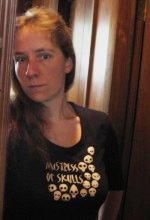
I tried (semi-successfully) to show both my pirate shirt and the skull earbuds. The eyes on the latter are supposed to light up, but aren’t so reliable. There’s a reason they were on the clearance rack, I think.

And, of course:

pirate attire

Feathers!

Not horsefeathers, but dinosaur feathers preserved in amber.

That’s so cool.

And a few other things to keep this from being a ridiculously short post…

Ada Lovelace Day is October 7 this year. I need to come up with a good topic, to follow my essays on Beatrix Potter and Elizabeth Blackwell.

Elizabeth Bear is interviewed at Terribleminds.

And let me share with you my earworm, entirely unrelated to anything else in this post.

Tell me a story

I finished revisions on the newest short story this weekend, and the first crits I’ve seen were very favorable. Yay! I pushed myself pretty hard with this one, and couldn’t tell whether the things I struggled to include were too much. Theme, dialog, unreliable narrator. Very exciting! It will be going out into the world shortly, there to be joined by its previously-rejected companions.

I tried a new approach to revisions. Rather than rereading and poking at it, retyped the whole thing, keeping theme and voice in mind the whole thing. I think it worked, by which I mean that it smoothed the whole thing out both stylistically and thematically. It took forever, though: I spent most of the day Saturday revising this 4000-word story. I’m thinking about subjecting the other stories waiting to be resubmitted to the same treatment before I send them back out.

I’m also starting to get itchy to work on long-form fiction. I have novel revisions to do, and I do really want to get Paper Magic finished (complete first draft, started revisions), followed by After the Dawn (about 80k words, perhaps half of which are salvageable, but I have a complete outline/synopsis). Both are YA fantasy, though unrelated.

Next in the queue after that are two adult fantasy novels: Underground (working title only), an urban fantasy/cozy that amuses me to no end (tropes! I can mess with them!), and a science fantasy novel that’s starting to gel. I figured out the major planning thingie that’s been bothering me last night, which makes me interested in it despite its lowly place in the queue. It has a working title, but I can’t tell you what it is.

Once I finish the next phase of the cursed work project I’ll have more brainspace for fiction, at least until the next thing comes along. My current difficulty isn’t juggling time so much as concentration: if I’ve spent 10-12 hours thinking hard about work, there’s time left but not brain.

I’m never going to be able to write every day, unless I do it just to create a habit while knowing that I’ll just be throwing those words away again. Which doesn’t seem all that helpful, really. I’m past the stage of writing for word’s sake; words now take thought and attention. That works fine for short fiction, but putting down a novel while my brain is employed elsewhere makes for a slow reentry period when I get to pick it back up again. I’m a master of leaving myself notes (novels aren’t the only large projects I have to do this to), but it’s still not ideal.

I’ve talked here before about writing every day, or not, and I’m sure I will again. It’s such a pervasive dictum in the writing community, one of the strongest “Thou musts.” Like any other always-true rule, it isn’t, but it still has the power to make me feel guilty when I run across it.

I completely agree that to be a writer you have to write, and to be a professional you have to submit, but there is not and never will be One True Way. If you want to write, figure out how that fits into your life. If it’s every day, that’s great, and you’ll be more productive. But if it’s only on weekends, that’s fine too, or if what you can manage given your time and brain allocation is binge writing between other projects, that’s fine too.

The only thing that’s bad is if you quit writing because you can’t do it the way Famous Writer X says you must.

Bookshelf 2.0 developed by revood.com